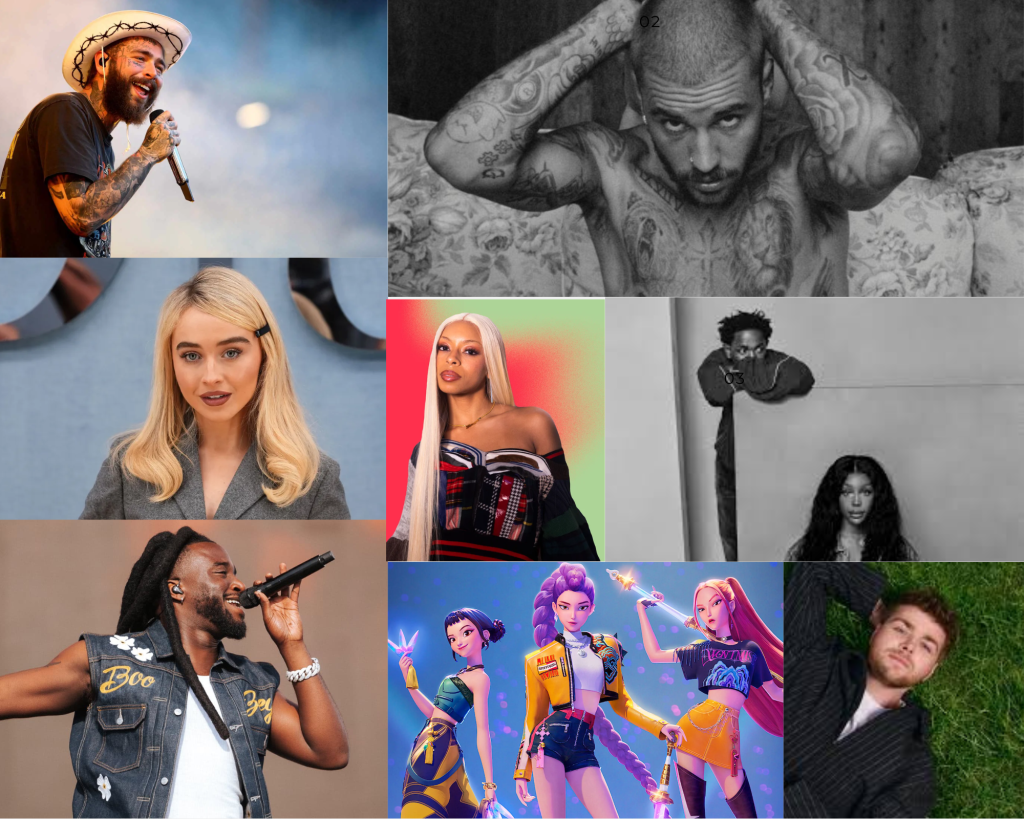
At summer’s end, a collective dialogue takes over to determine what people have been listening to from Memorial Day to Labor Day. Summer months have everyone out at the park, at the beach, connecting with friends and strangers while our ears pick up tunes emanating from car stereos, portable speakers, and backpack boomboxes.
In the summer, we share playlists for road trips, BBQs, and pool parties that we don’t hear once sweater weather takes over. Being outside lends itself to sharing a “song of the summer”. It’s up to us to decide if that song is the source of the trend or a theme that creates the soundtrack of a particular summer experience. Based on listening habits and how the general public consumes music now, our listening habits have become fragmented; the collective “Song of the Summer” may not register for everyone as a result of the fragmentation of singular media and culture.
Where someone lives, or who they’re interacting with, can influence what is considered to be the song of the summer. Ask 10 people in your friend group what their song of the summer has been the last two years, and you’ll likely be stuck with 10 different answers from the following:
| Songs in Conversation for Song of the Summer 2024-2025 | |
| 2024 | 2025 |
| Chappell Roan – Good Luck, Babe! | Justin Bieber – Daisies |
| Kendrick Lamar – Not Like Us | Alex Warren – Ordinary |
| Tinashe – Nasty | Kendrick Lamar/SZA – Luther |
| Tommy Richman – Million Dollar Baby | Huntr/x: Ejae, Audrey Nuna & Rei Ami – Golden |
| Espresso – Sabrina Carpenter | Ravyn Lenae – Love Me Not |
| Hozier – Too Sweet | Sabrina Carpenter – Manchild |
| Shaboozey – A Bar Song (Tipsy) | Morgan Wallen & Tate McRae – What I Want |
| Post Malone & Morgan Wallen – I Had Some Help | Teddy Swims – Lose Control (A song that stayed on Billboard charts for 2 years) |
Americans consume music differently than in the past. Take 40 years ago. You had MTV playing music videos 24/7, and the radio playing songs from Prince, Michael Jackson, Cyndi Lauper, or Madonna.
Today, music fans interact and engage with YouTube, streaming sites such as Spotify and Apple Music, TikTok, Instagram, Twitter, Reddit, and Discord to discover new music and share with friends. Radio still exists and songs still become popular, but there are thousands of other places we find our music these days.
How we engage with music is a far cry from previous generations, when songs were rattled off by Casey Kasem on American Top 40 or Carson Daly counting down songs on MTV’s TRL. There are many different sources from which we get our music. Listening to music on streaming or snippets of songs on social media has created different sources of listening where not everyone is drinking from the same well.
The song of the summer is not a designated award with a designated plaque or trophy, but more of a collective song on the Billboard charts to highlight what soundtracked the feel of the season or what was the common playlist that people congregated around. The Billboard charts are attempting to track the defining summer sound of a given year, but that determination has a flawed and drawn-out history.
Long before any Billboard charts or video countdowns existed, songs enthralled the general public during the Summer, dating back to the late 19th Century. This originated from published Tin Pan Alley sheet music publishing of the time. In the ascendancy of the music industry from the early business of songwriting and the development of technologies of the phonograph and the radio, songs were documented in the press that covered what songs people found inescapable.
In 1940, Billboard began recording its first ranking chart of popular recorded songs. By the mid 20th-Century, the development of industry metrics such as the Billboard Hot 100 could track record sales and radio play to determine the most popular song that the Song of the Summer became a notion to define what people listened to on the airwaves.
The monoculture of the past is over. Popular artists like Beyoncé, Taylor Swift, and Bad Bunny still stand out as unifying forces in an otherwise splintered audiological climate. If a song or album from one of the aforementioned artists releases but dissipates before the summer months, you’re left with stars without hits, and artists needing to be strategic on when to release music if being popular in summer is the main intent.
With the increase of artists terminally online to their fanbases, such as PinkPantheress and Addison Rae, who can tease snippets of music and engage with their fans, music percolating below mainstream audiences reaches out to different niches and groups can have instant feedback to become popular in the season where everyone is outside.
Our different music niches open avenues for different artists and scenes to reach our ears, rather than music by well-known artists meant to permeate in the summer months. Permeating trends in Country, Rap, and Dance music allow different artists to become popular to foster different moods and feelings that encompass the summer. A song can seemingly go viral overnight and still be virtually unknown to many. As opposed to having a song by a major pop artist be released in May with the expectation of being market-tested to become a summer song. This is truly beneficial as music fans are discovering artists or different genres through word of mouth and online, bypassing the traditional gatekeepers like radio, record labels that emphasize popular artists on selected playlists.
The move of MTV and BET stepping away from actually showing musical content, the homogenization of radio with iHeartRadio buying radio stations, and the decline of physical formats of music before the pandemic drove consumers to find music through streaming or video algorithms.
In the 1990s, with the tracking of charts and radio numbers, the idea of the song of the summer became an idea that could be tracked and clearly defined. In a 1995 article in New York Magazine, the song of the summer would need to have the following characteristics:
- Have to be released commercially during or near summer
- Be summarized similarly to a T-shirt slogan
- Enters the mind and stays there, years after the song is released
Now thinking about the songs that were discussed, would any of the songs mentioned above or from years past fit the following criteria on what defines a summer song? That definition may vary for listeners based on experience.
For my money’s worth, a song of the summer would be Carly Rae Jepsen’s inescapable and endearing Call Me Maybe from 2012, which has become refined with each listen now over a decade. Charli XCX’s year-defining Brat Summer of 2024 was memorable for the simplistic neon green album cover art plastered on t-shirts. Even Martha and the Vandellas’ venerable and electric Dancing in the Street from 1964, galvanized as an indirect anthem for the Civil Rights Movement, has been played for generations during sweltering days.
The Song of the Summer may not even be newly released, but a defining song that gives voice to what people are consuming or experiencing. Case in point: Kate Bush’s pulsating Running Up That Hill (Deal with God), released in 1984, skyrocketed in popularity after placement on the Netflix show Stranger Things in the Spring 2022, just in time for Summer. Hell, 2025’s song of the summer could honestly be the disco-tinged Hold My Hand by UK Singer Jess Glynne due to the Jet2Holiday ads transforming into memes flooding TikTok and Instagram pages, where a set of vacation ads originating in the UK expanding to highlight comical vacation follies.
A song of the summer in the purest sense of the definition may not exist in this current age. However, that does not matter. Consumption habits and algorithms all allow for different songs and artists to flourish and meet our ears at the right time.
There is a rising tide that lifts all boats, where mainstream artists can get play with a popular song, and the listening public can allow a lesser-known artist to garner traction over the summer.
The idea of having a unifying song of the summer is noble, but now listeners have an active role in defining that song, sharing their experience over the summer. Whether one traveled, danced, or was in their feels. We now have platforms and niches to fully express the songs that move us. In an uneasy and tumultuous summer, where one can enjoy the easy-going, laidback Daisies by Justin Bieber, I had my body and ears dancing to the infectious Illegal by PinkPanthress. For 2 minutes, I’m entranced in the balance of Pink’s bouncing duality of joy and anxiety, similar to my shared summer experience. We all have are own platform and the playlist to define our soundtrack for each summer, and that is a good thing.

 The Typecaster